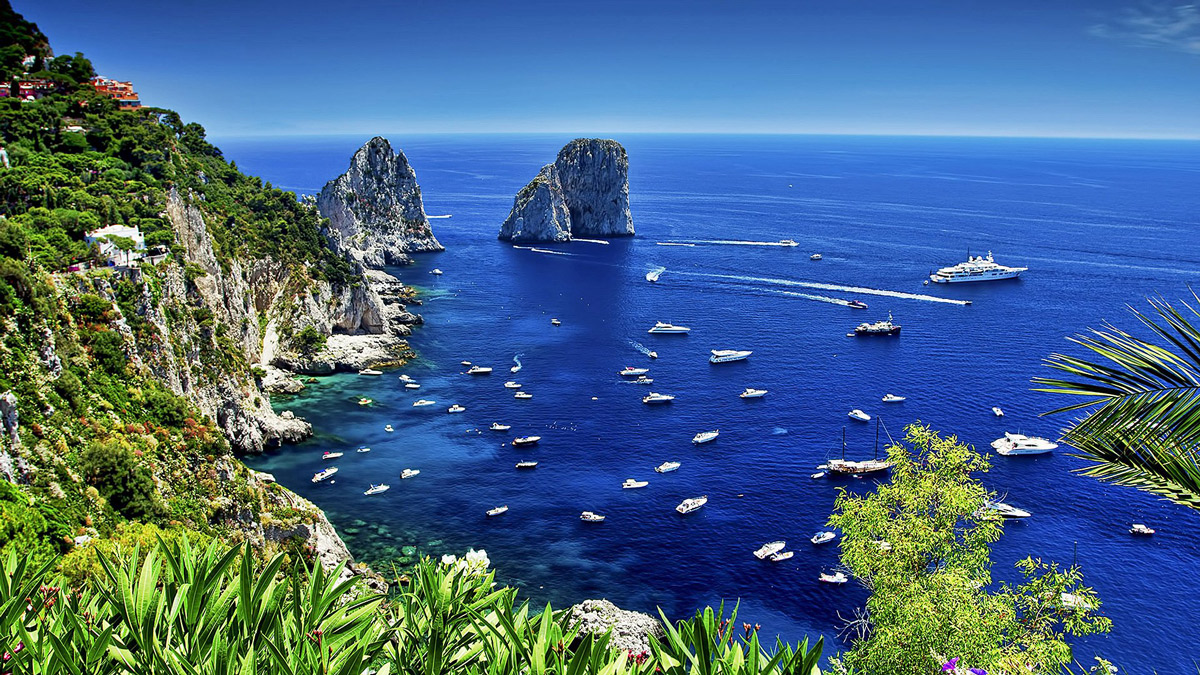
The Island of Capri
The island of Capri is among the most picturesque and most visited places in Campania. Its beauty and its fame have been known since ancient times when the ancients had linked it to the myths of Ulysses and the Sirens, and still today it attracts numerous visitors who make its breathtaking views their most coveted destination.
The island is of karst origin, separated from the mainland by a strait, and has numerous reliefs including that of Anacapri, which is the main one. The sea from which it emerges is particularly deep, the coasts are rugged, jagged, and rich in caves, among which the most famous is the Blue Grotto. But what is most striking, overlooking the sea, are the famous Faraglioni stacks: small rocky islets with the most varied shapes that seem to emerge from the deep blue waters, pointing straight towards the sky.
An Imperial Refuge: History & Legends
Capri for the Greeks and the Romans was the "island of goats", hence its name. The Roman Emperor Augustus did everything to obtain it from Naples in exchange for Ischia. His successor, Tiberio, fell so deeply in love with it that he built twelve villas, including the luxurious Villa Jovis (dedicated to Jupiter), a delightful voluntary exile from which he continued to govern the Roman Empire.
Due to later Saracen pirate raids, inhabitants took refuge at the highest point of the island, an impenetrable citadel between the walls and the Castiglione. After Lombard and Norman rule, Capri returned to its ancient splendor under the Angevins, who founded the grandiose Charterhouse of San Giacomo.
The continuous rise and fall of the tides—the phenomenon of bradyseism—means that Roman remains once on land are now completely submerged and can be seen rising directly from the waters inside the Blue Grotto. The modern tourist fame of Capri began in the mid-19th century with the rediscovery of this fascinating cave, turning it into an unmissable stop on the Grand Tour for international writers and artists.
Today, the architecture of the island displays typical "vaulted" houses, a traditional construction style used since Roman and Byzantine times to collect rainwater. In fact, water remains a rare and precious asset here, as the island has no natural springs and is supplied by naval tankers from the mainland. Administratively, the island is split into two rival municipalities: Capri and Anacapri.
📍 LINES & EXCURSIONS TO CAPRI
The island is easily accessible via regular maritime connections.
Reach the magnificent Blue Island aboard our comfortable motor ships departing from all main ports of the Island of Ischia. The excursion guarantees a generous shore stop of approximately 7 hours to explore the island at your own leisure.